
Dassault Systèmes and NVIDIA Bet on ‘Physical AI’ to Bring Industrial Simulation Into the Autonomous Era
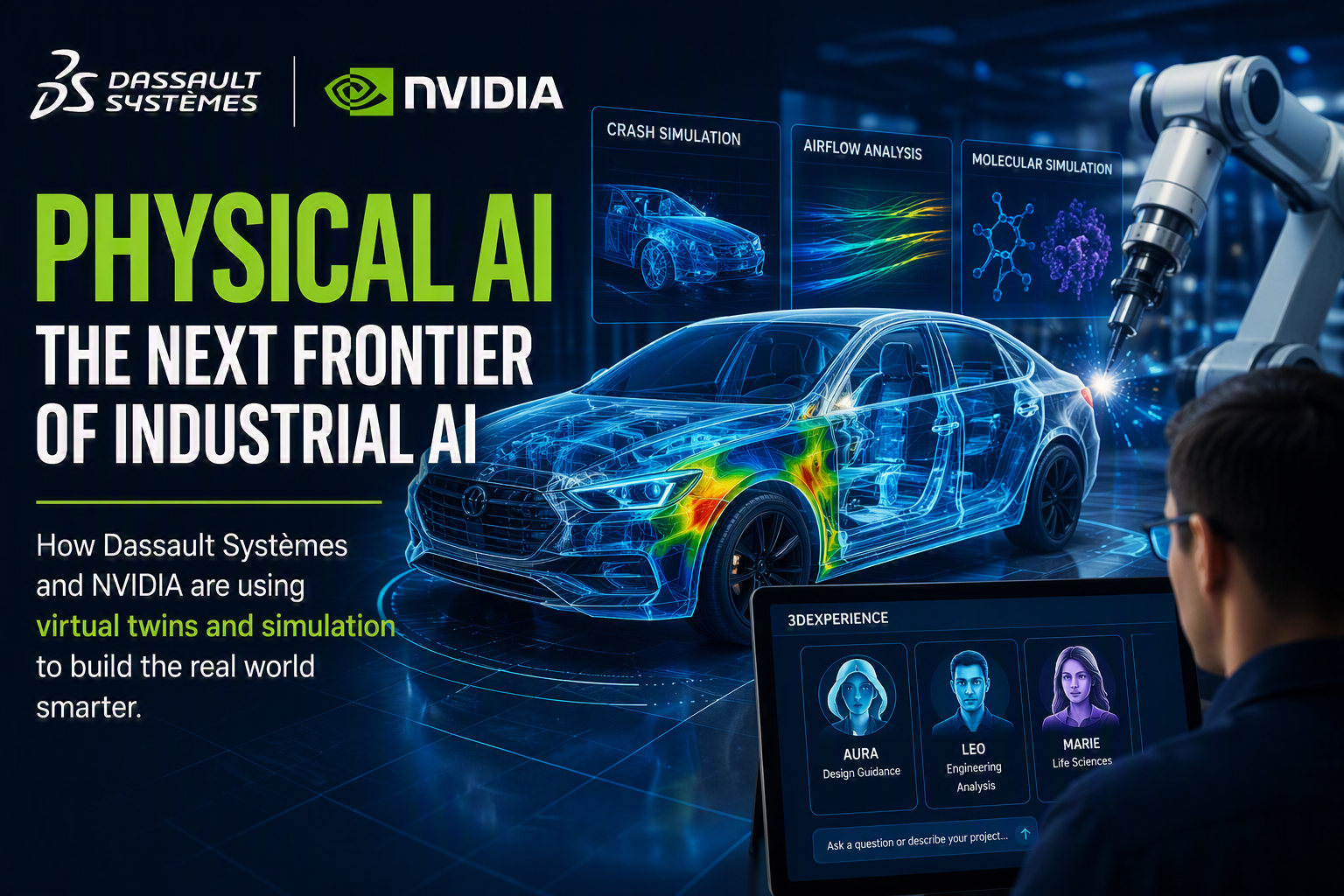
As generative AI reshapes software development, content creation and workplace productivity, a new frontier is emerging beyond chatbots and large language models. Industry leaders are increasingly focused on what they call Physical AI—artificial intelligence grounded not in text and images, but in the laws of physics, engineering and the real world.
At the centre of this shift is an expanded partnership between French software giant Dassault Systèmes and AI computing leader NVIDIA, which aims to combine advanced industrial simulation with AI-powered automation. The goal: enable engineers, manufacturers, pharmaceutical researchers and infrastructure planners to model and test complex systems in virtual environments before they are ever built.
According to Gian Paolo Bassi, Senior Vice President of Mainstream Innovation and Customer Role Experience at Dassault Systèmes, Physical AI represents the next stage of AI adoption—one where machines can reason about real-world behaviour through highly accurate digital models.
“Physical AI is linked to the ability to simulate the world,” Bassi said. “Digital simulation is fundamental for AI to be operative in the context of the physical world.”
The Rise of the Virtual Twin
Dassault Systèmes has long been known for its engineering and design software, including SOLIDWORKS, one of the world’s most widely used computer-aided design (CAD) platforms. Over the years, the company has expanded beyond design tools into sophisticated simulation technologies capable of modelling everything from aircraft aerodynamics to molecular interactions in drug development.
These capabilities underpin what Dassault calls virtual twins—dynamic digital representations of physical products, systems or processes that can be used to predict performance and outcomes.
By integrating NVIDIA’s AI infrastructure and accelerated computing technology, the company hopes to dramatically increase the scale and speed of those simulations. Rather than relying solely on historical data, engineers can create real-time digital environments that mimic reality closely enough to train AI systems, validate designs and anticipate failures before they occur.
The approach has implications across multiple sectors. Automotive manufacturers can conduct virtual crash tests, healthcare facilities can simulate airflow to reduce the spread of airborne pathogens, and logistics operators can optimise warehouse networks by modelling transportation routes and geopolitical risks.
For industries facing mounting pressure to innovate faster while reducing costs, the ability to experiment digitally before committing resources in the physical world is becoming increasingly valuable.
From CAD Software to Conversational Design
The company’s AI ambitions extend beyond simulation.
Bassi believes AI is transforming engineering in much the same way coding assistants are transforming software development. Rather than spending hours manually translating requirements into technical specifications, designers can increasingly describe what they want in natural language.
Historically, creating a product in CAD software required extensive expertise in geometry, engineering constraints and modelling techniques. Modern AI interfaces aim to lower that barrier.
“If the CAD technology is really smart, you can design a bookshelf yourself,” Bassi explained. “You don’t need an expert in computational geometry.”
This reflects a broader trend toward the democratization of engineering software. Just as generative AI has enabled non-programmers to build applications through conversational prompts, the next generation of design tools could allow users without deep technical training to create complex physical products.
For companies struggling to address engineering talent shortages, such capabilities could significantly expand access to advanced design technologies.
AI Assistants Built for Engineers
Earlier this year, Dassault Systèmes introduced a suite of AI-powered digital experts called Virtual Companions within its 3DEXPERIENCE platform.
Unlike general-purpose AI chatbots, these assistants are designed around industry-specific expertise.
One virtual companion, dubbed Aura, provides guidance on software usage, materials selection and regulatory compliance. Another, Leo, focuses on engineering analysis, helping users evaluate durability, performance and failure risks. A third, Marie, is tailored to life sciences applications, assisting with molecular research and pharmaceutical development.
The assistants are intended to operate across the entire product lifecycle, from initial concept through validation, production and ongoing optimisation.
Rather than replacing engineers, the company positions them as intelligent collaborators capable of making specialist knowledge more accessible.
Why Physical AI Matters
The concept of Physical AI has attracted growing attention as industries seek to move beyond purely digital applications of machine learning.
While generative AI models excel at producing text, images and code, real-world systems such as autonomous vehicles, robots and industrial equipment require a deeper understanding of physics and environmental constraints.
That challenge is where simulation becomes critical.
A self-driving car, for example, must constantly interpret and react to unpredictable physical conditions. Training such systems solely through real-world testing is expensive, slow and sometimes dangerous. High-fidelity simulations allow developers to expose AI models to millions of virtual scenarios before deployment.
NVIDIA CEO Jensen Huang recently described Physical AI as the next major wave of artificial intelligence, highlighting the company’s collaboration with Dassault as a way to merge industrial know-how with advanced AI infrastructure.
The partnership reflects a growing industry consensus that digital twins, simulation environments and AI agents will increasingly work together. Experts believe future engineering workflows may involve teams of human designers directing AI-powered systems that generate designs, test alternatives, identify risks and recommend optimisations autonomously.
Humans Still Ask the Questions
Despite the rapid advances in AI, Bassi rejects the notion that automation will eliminate the need for human creativity.
He argues that AI is best suited to handling repetitive and administrative work, allowing people to focus on higher-level problem solving and innovation.
The shift mirrors what has happened repeatedly throughout technological history. Computers automated calculations. Software automated documentation. AI is now automating portions of design, engineering and analysis.
But human judgment remains central.
“AI can provide the answers at unprecedented speeds,” Bassi said. “But humanity retains the most critical job of all—knowing which questions to ask next.”
As industrial companies race to adopt AI, that balance between automation and human expertise may become the defining feature of the Physical AI era. Rather than replacing engineers and scientists, technologies such as virtual twins and AI companions appear poised to turn them into orchestrators of increasingly intelligent digital systems—bringing computation closer than ever to the realities of the physical world.